
Danie Smit
General Manager BMW ZA IT Hub
Information Systems Researcher
Software Engineer
Research & Publications
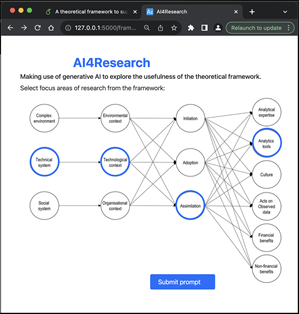
Integrating the TOE framework and DOI theory to dissect and understand the key elements of AI adoption in sociotechnical systems
Smit D., Eybers S., van der Merwe A., Wies R., Human N., Pielmeier J.
South African Computer Journal (2024)
Summary:
This study develops a framework using Technological-Organisational-Environmental (TOE) framework and diffusion of innovation theory to improve AI adoption success in organizations. The proposed framework is tested and evaluated by using with generative AI.
-> [paper]

Virtual reality in automotive digital twins: a large language model-assisted content analysis of an expert evaluation
Ka. D, Bosman I., Smit D.
Association for Computing Machinery (2024)
Summary:
Digital twins in automotive engineering benefit from Virtual Reality (VR), which simplifies complex data and enhances fault detection. Our study with 16 experts uses a new language model to highlight VR's potential and application in manufacturing, also showcasing the model's role in qualitative analysis.
-> [paper]

The impact of GitHub Copilot on developer productivity from a software engineering body of knowledge perspective
Smit D., Smuts H., Louw P., Pielmeier J., Eidelloth C.
AMCIS 2024 Proceedings (2024)
Summary:
This paper explores the impact of AI-assisted code completion, specifically GitHub Copilot, on software developer productivity in a leading automotive organization. Using a case study approach, the study evaluates how GitHub Copilot affects typical agile working metrics, such as throughput, cycle time, code quality, defects, and developer satisfaction, within the SPACE framework. The findings show improvements in several areas, leading to increased overall developer productivity.
-> [paper]
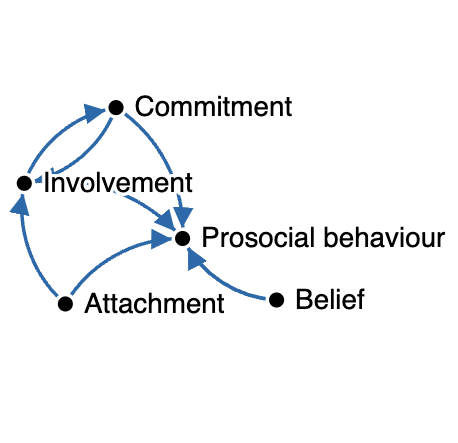
Key forces to building social ties among IT graduates: A case study
Smit D., Rossouw A., Smuts H., Denny K., Pielmeier J.
AMCIS 2024 Proceedings (2024)
Summary:
The paper investigates the key factors that contribute to the creation of social bonds in IT graduate programs, which help improve graduate retention and work readiness. The study uses a case study approach with 52 participants from a single organization, collecting data through a mixed-method survey based on social bond theory. It combines automated analysis with manual review and concludes that incorporating specific social bonding elements into graduate programs can give organizations a strategic advantage in the competitive IT sector.
-> [paper]
[Forces Diagram]
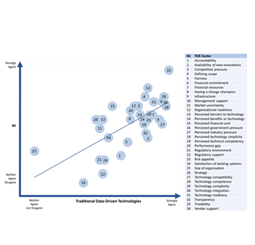
AI adoption in the corporate social responsible era: A model for practitioners and researchers
Smit D., Eybers S., van der Merwe A.
AMCIS 2024 Proceedings (2024)
Summary:
This paper presents an AI adoption model for responsible organizations, focusing on mitigating risks by addressing human impacts. It identifies three key themes for AI adoption: democratizing AI, managing the impact of AI's autonomous capabilities, and emphasizing human-centered AI. The study proposes an Artificial Intelligence Adoption Considerations Model (AIACM) to guide ethical and practical AI implementation.
-> [paper]
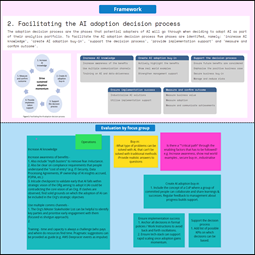
Towards Human-AI Symbiosis: Designing an Artificial Intelligence Adoption Framework
Smit D., Eybers S., van der Merwe A.
South African Computer Journal 36 (1) (2024)
Summary:
This paper proposes a sociotechnical framework for AI adoption in organizations, focusing on how to increase AI integration to become more data-driven. It uses a design science research approach, with a case study at an automotive manufacturer, to provide insights for both academics and practitioners.
-> [paper]
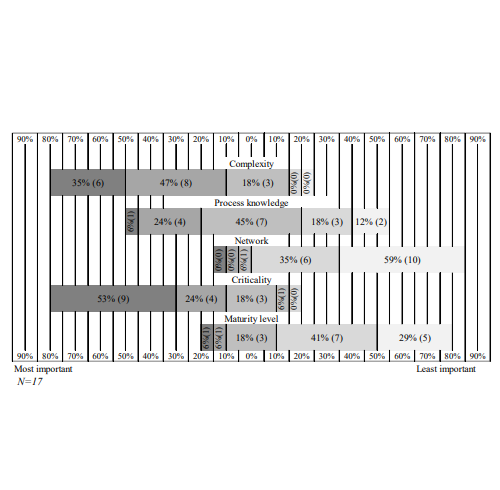
Optimal workforce allocation for quality delivery in DEVOPS teams: A case study
Smuts H., Louw P., Smit D., Waechter I., Sardinha-da Silva V.
IADIS International Journal on Computer Science and Information Systems (2024)
Summary:
This paper explores how IT organizations use DevOps to integrate development and operations for faster, more efficient product delivery. It develops a DevOps workforce profile using stratified systems theory and analyzes qualitative data to create guidelines for optimizing workforce allocation in product line teams.
-> [paper]
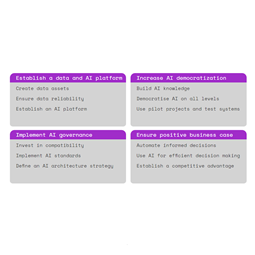
Designing a Technical Framework for Enabling Enterprise AI Adoption
Smit D., Eybers S., van der Merwe A., Human N.
In: Arai, K. (eds) Intelligent Computing. SAI 2024. Lecture Notes in Networks and Systems, vol 1016. Springer, Cham. (2024)
Summary:
This study, using an engaged research approach and Design Science Research, asks: What technical factors should organizations consider when adopting AI? It aims to propose a layered, technical-focused AI adoption framework.
-> [paper]

Let’s play games: Using no-code AI to reduce human cognitive load during AI solution development
Graaff A., Smit D., Eybers S.
Southern African Conference for Artificial Intelligence Research. pp. 86–99. Springer (2023)
Summary:
Making use of Tic-Tac-Toe to show that no-code AI reduces developer cognitive load.
-> [paper]
[Tic Tac Toe]
[Card Game]

Exploring the suitability of the TOE framework and DOI theory towards understanding AI adoption as part of sociotechnical systems
Smit D., Eybers S., van der Merwe A., Wies R.
Annual Conference of South African Institute of Computer Scientists and Information Technologists, pp. 229–240. Springer (2023)
Summary:
This study is interested in contributing to increasing the likelihood of achieving the organisational adoption of AI that has a positive outcome. AI is part of complex sociotechnical systems, and an organisation can be seen as a giant cybernetic collective, with a shared objective function.
-> [paper]
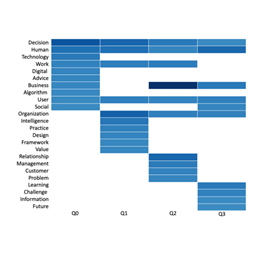
Exploring the social and technical factors in organisational AI adoption: A systematic literature review
Smit D., Eybers S., van der Merwe A.
Society 5.0 Conference 2023 (2023)
Summary:
This paper reviews 45 publications across the Basket of Eight and MIS Quarterly Executive. The study aims to highlight the state-of-the-art information systems research on organisational AI adoption and how to embed AI in organisations. A combination of manual analysis and augmented AI through topic modelling was utilised to conduct the systematic literature review.
-> [paper]

Technology days: An AI democratisation journey begins with a single step
Smit D., Eybers S., Sibanyoni N., de Waal A.
Artificial Intelligence Research: Third Southern African Conference, pp. 335–347. Springer (2022)
Summary:
Some organisations are setting up central AI teams. However, a central AI adoption approach is not always feasible, as domain knowledge, specific to each business unit, is often required. An alternative approach would be to democratise AI and position citizen data scientists across the organisation.
-> [paper]

A data analytics organisation’s perspective on the technical enabling factors for organisational AI adoption
Smit D., Eybers S., de Waal A.
AMCIS 2022 Proceedings. p. 11 (2022)
Summary:
Realising the benefits of utilising AI to support decision making whilst having the required skills with no available technology platforms, forms part of what is referred to as the Knowledge Attitude Practice gap (KAP gap). This paper focus on the technical aspects of the KAP gap and targets answering the following research question: What are the enabling factors to support the technical aspects of organisational AI adoption? A practice based research approach was followed, drawing on an exploratory case study, this study identifies and describes enabling factors to support the technical aspects of organisational AI adoption. The surveys were structured around the characteristics of innovation as postulated in the diffusion of innovation theory. Topic modelling and the subjective analysis of the text corpus were applied to organise the response into 14 technical enabling factors. The identified enabling factors can be used by managers to support their organisational AI adoption interventions.
-> [paper]
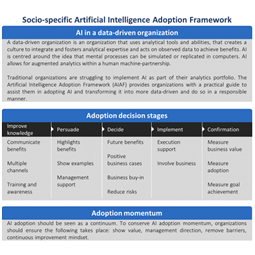
Towards a socio-specific artificial intelligence adoption framework
Smit D., Eybers S.
Proceedings of 43rd Conference of the South African Institute of Computer Scientists and Information Technologists, EPiC Series in Computing, vol. 85. vol. 85, pp. 270–282 (2022)
Summary:
Although technical adoption challenges are well researched and can overlap with aspects associated with traditional IT implementations, artificial intelligence adoption often faces additional social implication. This study focuses on these social challenges, which is a problem frequently experienced by many organisations.
-> [paper]
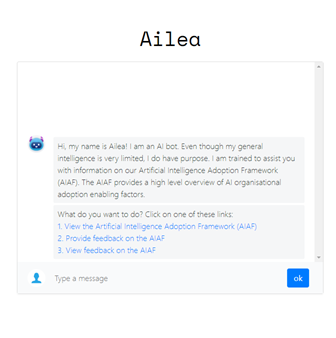
Evaluating design science research artefacts: A case of augmented AI
Smit D., Eybers S., Bierbaum L. A.
Presented at the International Conference on Design Science Research in Information Systems and Technology. St. Petersburg, FL, USA (2022)
Summary:
The problems that organisations will face in the future are uncertain; therefore, the exact requirements of artefacts are complex to predict. Design Science Research (DSR) artefacts come in many forms, such as constructs, models, methods or frameworks and are intended to solve organisational problems. We propose, build and evaluate an augmented AI solution to help continuously improve DSR artefacts.
-> [paper]
[Ailea]

The quest to become a data-driven entity: Identification of socio-enabling factors of AI adoption
Smit D., Eybers S., de Waal A., Wies R.
Information Systems and Technologies. WorldCIST 2022. Lecture Notes in Networks and Systems, vol. 468, pp. 589–599. Springer (2022).
Summary:
This study aims to identify the enabling factors that contribute to the successful adoption of AI, focusing on an analytics competence centre in a global manufacturing organisation.
-> [paper]

A data analytics organisation’s perspective on trust and AI adoption
Smit D., Eybers S., Smith J.
Communications in Computer and Information Science, vol. 1551, pp. 47–60. Springer (2022)
Summary:
This paper’s focus extends previous literature’s findings that fairness, accountability and transparency (FAT) influences trust and makes a theoretical contribution by confirming the indirect relationship between FAT, explainability, trust and adoption of AI in organisations. What makes our research finding of practical importance is not the finding that FAT and explainability leads to trust in AI, but rather the understanding that FAT and explainability will lead to a higher level of adoption in AI in organisations.
-> [paper]

Optimising the value chain in the automotive industry using B2B portals
Smit D., Kroeze J.H., Kirlidog M.
Business Transformation through Innovation and Knowledge Management: An Academic Perspective - Proceedings of the 14th International Business Information Management Association Conference, IBIMA 2010. vol. 1, pp. 484–495 (2010)
Summary:
Successfully implementing Information Communications Technology (ICT) projects is a significant challenge for ICT managers. This paper addresses this problem by adding insights regarding critical success factors of B2B portals in the automotive industry to the existing knowledge in the field of ICT.
-> [paper]